Two vehicles can be the same year, make, model, trim, and mileage yet still receive different offers. One reason is maintenance history.
When you sell your car, buyers want to know more than how it looks today. They also want clues about how the vehicle was treated over the years. Regular oil changes, scheduled service, documented repairs, and evidence that problems were handled before they became larger issues can make a vehicle easier to trust.
That does not mean a folder full of receipts guarantees a higher price. Vehicle condition, mileage, accident history, title status, local demand, and market trends still matter. Maintenance history is one part of the complete valuation picture.
Why Maintenance History Matters to a Buyer
A used vehicle always carries some uncertainty.
The buyer usually did not own the car during its earlier years, so they cannot personally know whether oil was changed on time, warning lights were ignored, fluids were neglected, or major repairs were completed correctly.
Service records reduce some of that uncertainty.
CARFAX includes service history among the factors used in its VIN-specific History-Based Value, along with accident history, ownership, registration history, recalls, and vehicle use.
A Documented History Can Answer Questions Such As:
- Were oil changes performed regularly?
- Was scheduled maintenance completed?
- Were brakes replaced when needed?
- Were major engine or transmission repairs documented?
- Were recalls handled?
- Was the vehicle maintained consistently over several years?
The stronger the documentation, the easier it becomes for a buyer to understand the vehicle’s past.
Regular Oil Changes Can Support a Better Value
Engine oil is one of the most basic maintenance items, but it can tell a buyer a lot about how the vehicle was treated.
Skipping oil changes can contribute to sludge, lubrication problems, and accelerated internal wear. A history showing regular oil service suggests that the owner followed one of the most important maintenance requirements.
CARFAX even uses regular oil-change history as one of its examples of how service records can affect vehicle value. In one comparison shown in its reporting, a vehicle with regular oil changes carried a higher History-Based Value than a similar vehicle with no reported service records.
Keep More Than the Last Receipt
One recent oil change does not prove the vehicle was maintained consistently.
A stronger record shows a pattern over time. That may include:
- Dealer service history
- Independent repair invoices
- Oil-change receipts
- Digital service records
- Maintenance app records
A buyer can then see that routine care was not just completed immediately before the sale.
Scheduled Maintenance Shows Long-Term Care
Vehicle manufacturers publish service schedules because different components wear at different rates.
Depending on the vehicle, scheduled maintenance may include:
- Engine oil and filters
- Cabin and engine air filters
- Spark plugs
- Coolant
- Transmission fluid
- Brake fluid
- Belts
- Tire rotation
Following those intervals can help show that the car received care before problems became obvious.
Why This Matters at Sale Time
Suppose two similar cars both have 80,000 miles.
One has records showing scheduled services at regular intervals. The other has no maintenance records beyond a recent inspection.
Even if both drive well today, the first vehicle gives the buyer more information about what happened during those 80,000 miles.
That can make the car easier to value and easier to sell.
Missing Records Do Not Automatically Mean Poor Maintenance
A car can be maintained properly without every service appearing in a commercial vehicle-history report.
CARFAX itself notes that its reports depend on information supplied by participating sources and do not contain the complete history of every vehicle.
That distinction matters.
You May Still Have Useful Proof
If a service is missing from CARFAX, you may be able to provide:
- Printed invoices
- Dealer receipts
- Repair-shop records
- Parts receipts
- Maintenance logs
These records can fill in gaps.
Do not assume that because a service history platform does not show a repair, the work has no value during a sale.
Major Repair Records Can Help Rather Than Hurt
Some owners worry that showing a major repair invoice will make the vehicle look unreliable.
That depends on what happened.
A documented repair can sometimes be more reassuring than an unexplained symptom or unknown history.
Examples Include
- New transmission
- Timing belt or timing chain work
- Water pump replacement
- Alternator replacement
- Suspension work
- Brake replacement
- Cooling-system repair
If the work was completed correctly and the vehicle has operated normally afterward, the invoice proves that the problem was addressed.
That is usually more useful than telling a buyer, “I think the previous owner fixed it.”
Deferred Maintenance Can Lower an Offer
Maintenance history does not only help when it is good. It can reveal upcoming expenses too.
A buyer may lower the offer when records suggest that major service is overdue.
Examples of Deferred Maintenance
- Oil change far beyond the recommended interval
- Old tires
- Brake pads near the end of their life
- Timing belt overdue
- Warning lights left unresolved
- Coolant or transmission service skipped
- Suspension noise ignored
The buyer is not only valuing the vehicle as it sits today. They are also estimating what they may have to spend soon after purchase.
That expected repair cost can reduce the offer.
Service Records Cannot Erase Accident History
A well-maintained car can still have a lower value because of previous damage.
CARFAX calculates vehicle value using several history factors at the same time, including accidents, title history, service history, number of owners, and vehicle use.
Think of Value as Several Layers
A car may have strong maintenance history but also major accident history, or no accidents but poor maintenance. Both histories affect the final valuation differently.
This is why maintenance should not be treated as the single deciding factor.
Vehicle Condition Still Matters More Than Paperwork Alone
A thick service folder cannot hide a car that currently has mechanical problems.
Buyers will still look at:
- Engine operation
- Transmission behavior
- Tires
- Brakes
- Suspension
- Warning lights
- Paint and body condition
- Interior condition
Kelley Blue Book also uses current vehicle condition, market data, vehicle details, and local conditions when estimating value.
Records Support Condition
The strongest situation is when the paperwork and the vehicle agree.
A car that drives well and has consistent service documentation is easier to evaluate than a car with excellent paperwork but obvious current problems.
Mileage and Maintenance History Work Together
Mileage is one of the first things buyers see, but mileage alone does not tell you how the car was treated.
A higher-mileage vehicle with consistent maintenance can sometimes be more appealing than a lower-mileage car with poor service history.
Example
Vehicle A: 70,000 miles, several missing service intervals, old tires, warning light.
Vehicle B: 95,000 miles, regular oil changes, documented maintenance, recent brakes and tires.
The lower-mileage car may still have a higher book value in some situations, but the second vehicle can be easier for a buyer to trust.
Maintenance helps explain the mileage rather than replacing it as a value factor.
One Owner With Good Records Can Be Attractive
Ownership history also affects how buyers interpret maintenance.
CARFAX uses the number of previous owners as one of the factors in its vehicle valuation.
A one-owner car with complete maintenance records creates a simple history. The buyer can see:
- Who maintained the car
- How long they owned it
- Where service was performed
- Whether maintenance was consistent
A multi-owner vehicle can still be maintained well, but records may be scattered between several people and shops.
Dealership Service Is Useful, but Independent Shop Records Count Too
Maintenance does not need to be performed only at a dealership to help your car’s sale.
Independent repair facilities can provide valuable documentation as long as the invoices clearly show what was done.
A Useful Service Invoice Should Show
- Date
- Mileage
- Vehicle information
- Work performed
- Parts replaced
- Shop information
Consistency matters more than the logo at the top of the receipt.
A complete independent-shop history can be more useful than a few dealership records followed by several years with no documentation.
Can DIY Maintenance Help Your Car’s Value?
It can, but documenting it is harder.
If you perform your own oil changes or minor repairs, keep records. Save:
- Parts receipts
- Oil receipts
- Filter receipts
- Dates
- Mileage
- Notes about work performed
This will not always carry the same weight as third-party shop documentation because the buyer cannot independently verify the work as easily.
Still, organized records are better than no records.
Should You Repair Everything Before You Sell Your Car?
Not necessarily. Some repairs can improve saleability, while others may cost more than they add to the selling price.
Repairs That Often Make Sense to Consider
- Burned-out lights
- Low fluids
- Small maintenance items
- Worn wiper blades
- Minor warning-light causes
- Basic service due soon
Repairs That Need More Calculation
- Transmission replacement
- Major engine repair
- Extensive body work
- High-cost suspension work
Before spending several thousand dollars, compare the likely repair cost with the increase in vehicle value.
Sometimes selling the car in its current condition makes more financial sense.
A Pre-Sale Inspection Can Strengthen Your Position
If you expect to sell privately, a recent inspection can give buyers more confidence.
An inspection may identify:
- Brake condition
- Tire condition
- Fluid leaks
- Suspension wear
- Warning codes
- Maintenance needs
You can then decide which items to repair and which to disclose.
Disclosure Can Be Better Than Surprises
If the car needs brakes in the next few months, a buyer may prefer knowing that before the sale.
Unexpected problems discovered during a pre-purchase inspection can create more aggressive price negotiations.
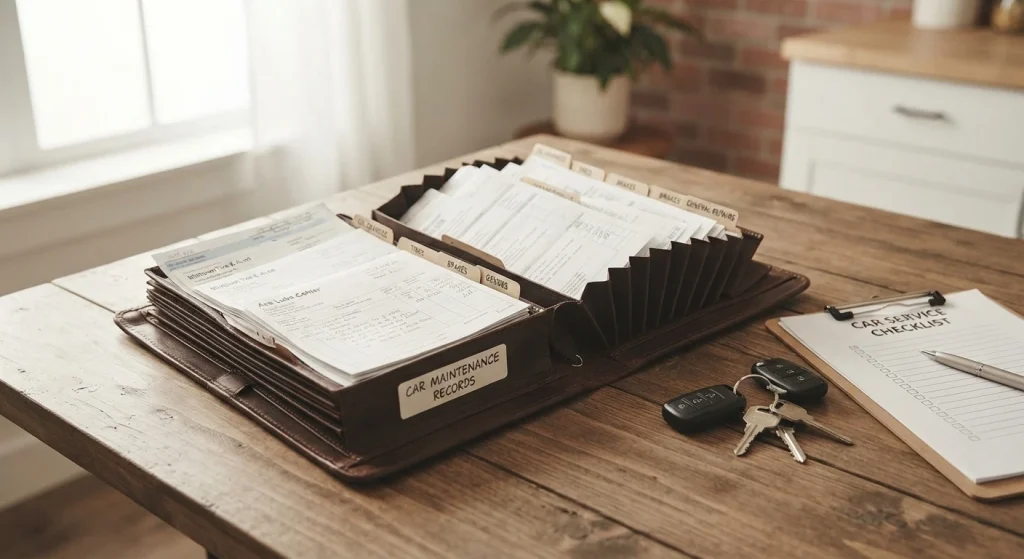
Organize Maintenance Records Before You Advertise
Do not hand a buyer a box of random receipts.
Create a simple history.
Start With a Timeline
For example:
| Mileage | Maintenance or Repair |
|---|---|
| 30,000 | Transmission service |
| 45,000 | Tires replaced |
| 60,000 | Spark plugs |
| 72,000 | Front brakes |
| 78,000 | Battery |
| Regular intervals | Oil and filter changes |
Attach the supporting invoices behind the summary.
This makes the maintenance record easier to understand during the sale.
Do Not Invent Missing Service History
If you cannot prove that a maintenance item was completed, do not claim it was.
A buyer may check a vehicle history report, contact previous service facilities, or inspect the car.
Be accurate about what you know. Say: “I do not have a record for that service,” rather than assuming a previous owner must have done it.
Credibility during the sale has value too.
Get an Updated Vehicle Value Before Setting Your Price
Your car’s previous purchase price does not tell you what it is worth today.
Kelley Blue Book updates vehicle values using market transactions, local conditions, seasonality, and other factors, while CARFAX incorporates vehicle-specific history including service records.
Compare:
- Current mileage
- Condition
- Trim and options
- Maintenance history
- Accident history
- Local market
- Trade-in value
- Private-party value
This gives you a better starting point before negotiating. If your car’s registration has lapsed since you last checked its value, our earlier guide on selling with expired registration covers what still needs to happen before you set a price.
Maintenance Records Are Especially Useful When Two Cars Look Similar
Imagine a buyer comparing two nearly identical used vehicles.
The first seller has:
- Oil-change history
- Brake receipts
- Tire replacement records
- Recent inspection
- Major service documentation
The second seller says: “The car has always been taken care of.”
The first vehicle gives the buyer something concrete to evaluate.
That does not guarantee a specific premium, but it can reduce uncertainty and strengthen the seller’s position.
Pre-Sale Maintenance History Checklist
Before you sell your car, gather as much reliable documentation as you can. Our complete checklist for selling a car covers the full pre-sale process beyond maintenance records alone.
Routine Service
- Oil changes
- Filters
- Fluid services
- Tire rotations
- Spark plugs
Wear Items
- Tires
- Brakes
- Battery
- Belts
- Suspension components
Major Repairs
- Engine work
- Transmission work
- Cooling-system repairs
- Electrical repairs
- Recall documentation
Vehicle Records
- Current mileage
- Title
- Registration
- Service invoices
- Vehicle history report where useful
Organized documentation helps the next owner understand what has already been done and what may be coming next.
A Good Maintenance History Can Make Your Car Easier to Value and Sell
A car’s maintenance history affects value because it provides evidence about how the vehicle was cared for before the sale. Regular oil changes, scheduled maintenance, documented repairs, and recent wear-item replacement can reduce uncertainty, while long gaps and deferred repairs can give a buyer reasons to lower the offer. CARFAX specifically includes service history among the factors used to calculate its VIN-specific vehicle values.
If you are ready to sell your car, gather the title, registration, maintenance records, and information about the vehicle’s current condition before requesting offers. Cash Your Car NJ purchases used, older, high-mileage, damaged, and other vehicles across New Jersey, and its selling process allows owners to provide vehicle details for an offer before scheduling pickup. Request an offer from Cash Your Car NJ when you are ready to compare the vehicle’s current value with the cost of keeping or repairing it.