Getting rid of an old vehicle can seem straightforward. Find a buyer, arrange a pickup, hand over the keys, and move on.
In New Jersey, however, there are a few details that should not be overlooked.
Whether the vehicle is damaged, no longer running, badly rusted, or simply too expensive to keep repairing, the process of selling it for junk involves more than finding someone willing to take it away. Your title, license plates, insurance, vehicle identification number, and the paperwork surrounding the transaction all deserve attention.
If you plan to junk a car in NJ, avoiding a few common mistakes can make the process considerably easier.
The good news is that most of these mistakes are preventable. You do not need to become an expert in New Jersey motor vehicle law. You simply need to understand what documents you have, what condition the vehicle is in, and what needs to happen before and after the sale.
1. Assuming a Junk Car Has No Value
One of the first mistakes people make is assuming that an old or damaged vehicle is automatically worthless.
A car that no longer makes sense to repair can still have value as a source of parts or recyclable materials. Its condition, age, make, model, demand for components, weight, and location can all influence what a buyer may be willing to offer.
A vehicle does not necessarily need to be roadworthy to have a market.
For example, a car with a failed transmission may still contain usable body panels, wheels, interior components, catalytic equipment, electronics, or other parts. A severely damaged vehicle may have less parts value but still contain recyclable metals.
This is why it is worth getting an actual offer instead of assuming that the vehicle has no remaining value.
2. Trying to Sell the Vehicle Without Proof of Ownership
Ownership documentation is one of the most important parts of the transaction.
For many vehicles, the certificate of title is the document that establishes ownership and allows the vehicle to be transferred properly.
If you are preparing to junk a car in NJ, locate the title before scheduling the transaction.
Check the title for:
-
Your name
-
The vehicle identification number
-
Any co-owner information
-
Lienholder information
-
Existing title branding
-
Errors or inconsistencies
The VIN on the paperwork should correspond with the VIN on the vehicle.
New Jersey’s Motor Vehicle Commission maintains specific procedures for title transactions and has separate documentation for vehicles receiving a junk title.
If your title has been lost, do not simply assume that a buyer can ignore the issue. Contact the New Jersey MVC to determine what replacement or alternative documentation may be available for your situation.
3. Ignoring a Lien on the Vehicle
A loan can complicate the sale of a junk vehicle.
If you financed the vehicle and the loan has not been completely paid off, the lender may still be listed as a lienholder.
You cannot simply treat the vehicle as though you have unrestricted ownership because it is being sold for parts or scrap.
Before arranging the sale, check your title and loan records. If a lien remains, find out what documentation is necessary to release it.
This is particularly important when a vehicle has very little market value. The fact that a vehicle is being junked does not automatically eliminate a lienholder’s interest.
Resolving the paperwork before the pickup can prevent a transaction from becoming unnecessarily complicated.
4. Forgetting to Remove Your License Plates
License plates should not simply stay on the vehicle after you sell, junk, or destroy it.
New Jersey MVC guidance states that if a vehicle is sold, junked, or destroyed and you do not intend to purchase another vehicle, the license plates must be surrendered to the MVC for cancellation.
If you are transferring eligible plates to another vehicle, different rules apply.
This is an easy detail to overlook because the vehicle itself may no longer be driven.
Before the junk vehicle leaves your property, determine what you need to do with the plates. Keep any applicable receipt or proof of surrender with your records.
5. Canceling Insurance at the Wrong Time
Insurance and vehicle disposal should be handled in the right order.
New Jersey requires private passenger vehicles to maintain automobile liability insurance while they are subject to the state’s insurance requirements.
If you are getting rid of a vehicle, do not assume that the correct approach is to immediately cancel the insurance before completing the sale.
Make sure the ownership and vehicle status have been properly handled and speak with your insurance company about when coverage should be changed or canceled.
The exact situation can depend on whether you still own the vehicle, whether it remains registered, whether you have another vehicle, and what your insurer requires.
The important point is to coordinate the insurance change rather than making an assumption based solely on the fact that the car is no longer being driven.
6. Failing to Check the Vehicle Identification Number
The VIN is more than a number used to identify your vehicle.
It connects the physical vehicle with its title and motor vehicle records.
Before completing a transaction, compare the VIN on your title with the VIN on the vehicle.
Look for inconsistencies, altered markings, missing characters, or other issues.
The New Jersey State Police Auto Unit also advises vehicle buyers to verify that the VIN on the title matches the VIN on the vehicle.
For someone selling a junk car, checking the VIN can help identify a documentation problem before the transaction takes place.
If the VIN information does not match your paperwork, stop and resolve the discrepancy rather than trying to proceed with the sale.
7. Hiding the Vehicle’s Condition
A junk vehicle does not need to be described as something it is not.
If the car has major mechanical problems, flood damage, fire damage, collision damage, missing components, or extensive rust, provide accurate information to the buyer.
This is particularly important when requesting a quote.
A buyer may ask:
-
Does the engine run?
-
Does the vehicle start?
-
Is the transmission functional?
-
Does the car roll?
-
Is the catalytic converter present?
-
Is the vehicle complete?
-
Is there major accident damage?
-
Is the title available?
-
Where is the vehicle located?
Answering these questions accurately helps the buyer evaluate the vehicle.
It can also prevent confusion if the vehicle’s condition is substantially different from what was originally described.
8. Assuming Every Junk Car Needs the Same Paperwork
Not every vehicle has the same circumstances.
A standard titled vehicle, a vehicle with a salvage designation, a vehicle with a lien, and a vehicle requiring a junk title can involve different documentation.
New Jersey MVC has a specific Application for Junk Certificate of Title. That document asks for information about the vehicle, owner, co-owner, lienholder, mileage, VIN, and the type of loss suffered.
That does not mean every private owner needs to obtain a junk certificate before selling a vehicle to a junk-car buyer.
Instead, it demonstrates why you should understand the vehicle’s existing title status rather than assuming that every unwanted car follows the same process.
If you are uncertain about the title classification, check with the New Jersey MVC.
9. Waiting Until Pickup Day to Find Your Documents
This mistake can create unnecessary delays.
Before scheduling a pickup, gather the documents and information you are likely to need.
Keep these items accessible:
-
Vehicle title
-
Driver’s license or other identification
-
Vehicle registration information
-
VIN
-
Lien release, if applicable
-
Any relevant insurance information
-
License plates
You should also remove personal belongings from the vehicle.
Check the glove box, center console, trunk, door pockets, under seats, and other storage areas.
People often leave important items behind when they are focused on getting rid of an old vehicle.
10. Forgetting to Remove Personal Information From the Car
Modern vehicles can contain more personal information than people realize.
Before the car is picked up, check whether it contains:
-
Garage door remotes
-
Parking permits
-
Toll transponders
-
Insurance documents
-
Registration paperwork
-
Service records containing personal information
-
Navigation history
-
Bluetooth-paired phones
-
Saved addresses
-
Personal belongings
If the vehicle has an infotainment system, consider performing the manufacturer’s recommended reset or removing personal accounts and paired devices.
A junk car can still contain information that you do not want to pass along with the vehicle.
11. Assuming You Need to Drive the Car to the Buyer
A junk vehicle may not be safe or practical to drive.
If the vehicle has been sitting for a long period, has major mechanical problems, lacks required equipment, or has significant accident or structural damage, do not take unnecessary risks just to deliver it.
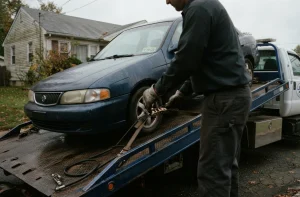
Ask about vehicle pickup and towing arrangements when requesting a quote.
This is especially important for cars that no longer start or cannot safely operate on public roads.
The transportation question should be addressed before the sale rather than after you have already agreed to the transaction.
12. Choosing a Buyer Based Only on the Highest Number
The largest number in an initial conversation is not necessarily the amount you will ultimately receive.
When comparing junk-car buyers, look at the entire transaction.
Ask:
-
Is the quoted amount conditional?
-
Is towing included?
-
Are there pickup fees?
-
What paperwork is required?
-
When will payment be made?
-
Does the buyer accept the vehicle’s current title status?
-
Can the buyer legally handle the vehicle?
A slightly different offer may have a different overall value depending on what is included.
For example, if one buyer provides a straightforward pickup arrangement while another quote comes with additional conditions or transportation costs, the numbers may not be directly comparable.
Get the terms clear before agreeing to the sale.
13. Leaving the Vehicle Sitting After the Sale
Selling the vehicle is not the end of the paperwork.
Once the transaction is complete, keep records showing what happened.
Depending on the circumstances, useful records may include:
-
A copy of the signed title
-
Bill of sale, if used
-
Buyer information
-
Pickup documentation
-
Payment record
-
License plate surrender receipt
-
Relevant communication about the transaction
Keep these documents for your records.
If questions later arise concerning ownership, registration, insurance, or the vehicle’s disposal, having documentation can make it easier to establish what happened and when.
14. Assuming a Junk Title and Salvage Title Mean the Same Thing
The words “junk” and “salvage” are sometimes used casually as though they describe the same situation.
They do not necessarily mean the same thing under New Jersey’s motor vehicle system.
New Jersey MVC maintains separate title classifications and procedures for vehicles with salvage and junk branding.
A salvage designation can relate to a vehicle that has sustained significant damage and may potentially be repaired under applicable requirements.
A junk title is associated with a vehicle intended for dismantling or other non-road use.
Because title branding affects what can happen to a vehicle afterward, do not guess about the classification.
Check the title and use the appropriate New Jersey MVC guidance for the vehicle’s circumstances.
15. Trying to Handle Hazardous Materials Yourself
Old vehicles can contain fluids and components that should not be treated like ordinary household waste.
Depending on the vehicle, these may include:
-
Motor oil
-
Coolant
-
Brake fluid
-
Fuel
-
Refrigerants
-
Batteries
-
Other automotive fluids or materials
If a vehicle is being dismantled, specialized businesses generally have processes for dealing with these materials.
A homeowner should not assume that draining everything into a container and putting it in the trash is an appropriate disposal method.
If you are unsure about a particular material, check the relevant New Jersey environmental or municipal disposal guidance.
What Should You Do Before You Junk a Car in NJ?
A simple checklist can make the process easier.
Step 1: Locate the title
Confirm that you have the appropriate ownership document.
Step 2: Check for a lien
Make sure you understand whether another party has a legal interest in the vehicle.
Step 3: Record the VIN
Compare the VIN on the vehicle with the title.
Step 4: Gather vehicle information
Know the year, make, model, mileage, condition, and location.
Step 5: Remove personal property
Search the entire vehicle before pickup.
Step 6: Understand your plate obligations
Determine whether the plates need to be surrendered or transferred.
Step 7: Coordinate insurance
Contact your insurer about changing or ending coverage at the appropriate point in the transaction.
Step 8: Compare the complete offer
Ask about pickup, towing, paperwork, payment, and any conditions.
Step 9: Keep transaction records
Save your documentation after the vehicle leaves your possession.
What Is the Easiest Way to Junk a Car in NJ?
For many owners, the biggest challenge is not finding someone interested in the vehicle. It is coordinating the paperwork, vehicle condition, pickup, and ownership details.
A straightforward process begins with accurate information.
Know whether you have the title. Check whether there is a lien. Confirm the VIN. Remove your plates and personal belongings as appropriate. Then provide the buyer with an honest description of the vehicle.
If the vehicle does not run, establish how it will be picked up before completing the transaction.
These steps can reduce the chance of surprises and make it easier to compare your options.
Turn Your Unwanted Vehicle Into a Straightforward Sale With Cash Your Car NJ
If you are ready to junk a car in NJ, Cash Your Car NJ can be an option to consider when looking for a way to move on from an unwanted vehicle.
The best place to start is with the basics: your title, vehicle information, VIN, condition, and pickup location. Once those details are available, you can ask about the selling process and determine what documentation is needed.
A junk car does not have to become a complicated project. Avoiding common mistakes, understanding your New Jersey MVC responsibilities, and keeping a record of the transaction can make the process much more organized.
Whether the vehicle is old, damaged, non-running, or simply no longer worth maintaining, taking care of the paperwork before the pickup can help you complete the sale with fewer surprises.